St. Beuno's, Culbone: From Celtic Beginnings To The Living Years


By Luke Knight
"Shall we go for a walk? I know this great coastal path that takes us to this hidden church in the woods - you'll love it".
That is (pretty much) what I said to my girlfriend back in July 2023, when we were contemplating what to do with our day. Little did I know, that my suggestion - a walk to St. Beuno's Church, in Culbone - would be the catalyst to my creating Knight Tales.
I have been fortunate to visit Culbone, more than once, but most of my visits saw me being driven down from the top of the valley. Usually by a local expert or churchwarden. Time was always of the essence when recording for the BBC, and you don't walk to Culbone in 10 minutes. But rest assured, my visit in 2023 was done on foot, from Porlock Weir, and I have to say, it is one of the best walks you can do.
If you follow the signposts from the galleries in Porlock Weir, you can't really go wrong. Take some sturdy walking boots though, and expect some hilly terrain. The coastal path has experienced landslides in the last few years, so the flatter routes have been closed off, and the diversion routes go up some gnarly inclines, which some may find challenging. But along the way, you will be rewarded by seeing some relics of the past...

Within a mile or so of leaving Porlock Weir you will come across whats left of the structures and tunnel, of the Ashley Combe Estate - Ada Lovelace's summer retreat. If you don't know who Ada Lovelace is, then Google her immediately...come back to this article when you're ready...I'll wait...
Not only was she a mathematical genius, but also a lover of nature. Much of the landscape that you will walk, to get to Culbone, has been influenced by Ada Lovelace, as she helped to create dynamic landscapes that complimented the rugged views of the now South West Coastal Path. Just be aware that a lot of the old Ashley Combe estate is privately owned, by the descendants of Ada Lovelace...so please respect the signs, and don't trespass for the sake of a photo.
Most importantly, enjoy the walk. It can be a very peaceful way of forgetting the madness of the modern world.

When you arrive in Culbone, it won't take long to look around. But it's worth staying a while, to take in the peace and tranquility of the place. Imagine it; all the people that have come to live and be in this perfectly hidden little hamlet, for hundreds of years. Many have called it home. I remember having a conversation with Deborah Stanyon from the Porlock Information Centre, who said it was her 'paradise'; and one of the reasons she moved to the area. I even witnessed a gentleman tending to his ancestor's headstone in the churchyard. How wonderful a moment that was to see - that people still honour their relatives here.
What is the history of this place then?
Culbone is pre-norman, with records first mentioning it in 1086, in the Domesday Book. The settlement is referenced as having 4 households, 50 acres of pasture and 100 acres of woodland. Nowadays, it only has two houses, and the tiny church that forms the central part of Culbone - which is dedicated to the 6th‑century Welsh saint, St. Beuno, (pronounced BYE-NO). It hints at the church’s deep Celtic Christian origins, and aligns it with a chain of early monastic sites along the Bristol Channel - places like Congresbury, Watchet, Porlock, Braunton, and Hartland - all linked to missionary centres in Glamorgan, such as Llantwit Major and Llancarfan.
The church itself is one of the smallest you will come across. At a grand total of 35 feet long, there is some discussion as to what title it holds; but it's thought to be one of the smallest 'still-used' parish churches in England. That is very apparent when you go inside, of course...

When you enter through the stone porch (which was built much later, by the way), you will see that it has many 'churchy' features, similar to that of a full-sized church. On the left you will see a well-loved piano and font, along with bell ropes, and on the right you will see the nave, with only enough pews to seat up to 30 people. I'm told they have had wedding ceremonies take place in here, with up to 40 people in attendance. I think its fair to say it was joyous, but rather uncomfortable. That figure is also regularly met at Christmas time, when the annual carol service takes place. Its a service I am yet to experience. I bet it's something to behold.

See that enclosed area on the right-hand side of the nave? I am told that is where Ada Lovelace and her family would have sat, when they frequented services during their visits to Ashley Combe.
Make sure you sign the visitor book on your way out!
When you step back outside, make your way to the rear of the church. On the north facing wall you will find a couple of interesting features. The first is the double paned Anglo-Saxon window; the second is a narrow 'window' called a Leper's Squint. Which is a nod to when Culbone was a Leper Colony between 1544 to 1622.

As Culbone was such an isolated community, its woodland was identified as being a good place to house people who had leprosy - many of whom were charcoal burners. Whilst those with leprosy weren't allowed into the village, they were permitted to 'attend' services at the church, by looking through the small 'Leper's Squint'. That way they could at least be part of the communion.
As well as being a leper colony, in the 14th century Culbone was also used as a colony for French prisoners, and again in 1720 as a prison colony.
A haven for folklore and spiritualism
When I first visited Culbone, in 2018, I was given a tour by former resident, Jeff Cox, who walked me down from the top of the valley, and on the way we had a long and deep conversation about what the valley mean't to him. He discussed in great depths of emotion about how spiritual the valley was, and told me stories of how Jesus and his uncle, Joseph of Arimathea, visited the valley when Jesus was a child. He also told me about his friendship with fellow Culbone resident Joan D'Arcy Cooper, the American psychologist, author, yoga teacer and lay reader, and how he also ran a 'refreshment station', with his wife, for all of the coastal path walkers that might visit Culbone.
My favourite story though, dives into the pool of folklore. Jeff pointed and ushered me to look at the spire on top of St. Beuno's Church.
"Now, have you seen the spire on top of St. Dubricious Church, in Porlock?", Jeff said.

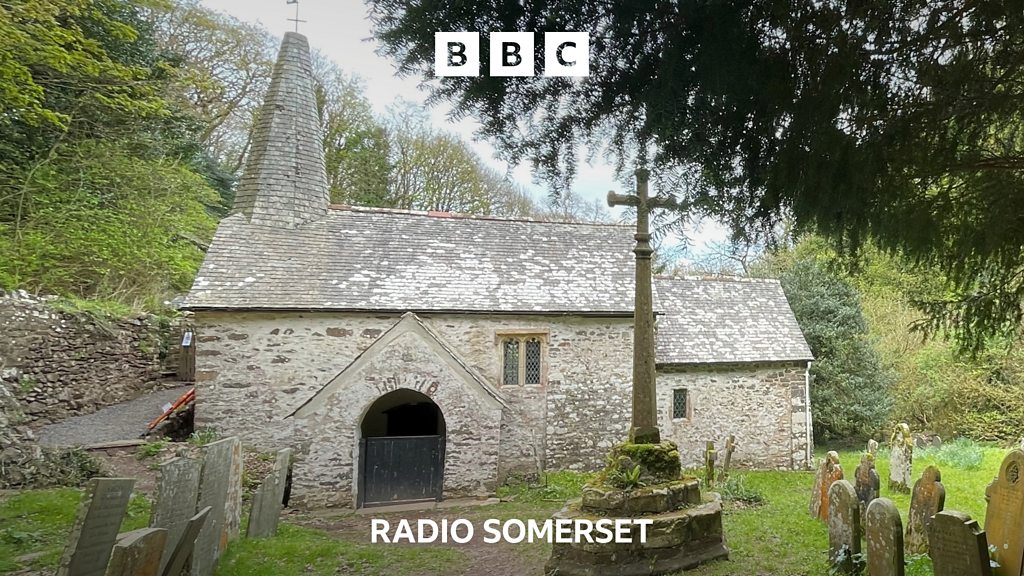
You will notice that Porlock church is missing the tip of its spire. Now, scroll back to the top of this article and have a look at the spire of St. Beuno's Church.
You can see where this is going can't you...
Officially, no one really knows why Porlock church is missing it's tip. Some records suggest that it came down in the Great Storm of 1703. But, Jeff told me a couple of short and sweet folklore stories that have stuck with me to this day.
The first is that when the storm blew the spire off of Porlock Church, a few of those inmates from the prisoner colony managed to steal the spire under the cover of darkness and carry it back to Culbone, for their own church. But I prefer the next story.
The Devil was angry at how well Porlock church was doing, so took a big swipe at the church; knocking the spire from the steeple. The spire would then eventually land on the church at Culbone. You can't deny, it does look like it could fit.
If you are blessed with good health then please consider making your next adventure a walk to Culbone. I have to say, Mike + The Mechanics made a great song that you can listen to along the way...notice anything familiar in the music video?
If you'd like to hear more about Culbone, it's church, and some wonderful memories from visitors and volunteers, then you can also listen to this special episode I produced for Secret Somerset on BBC Radio Somerset:


Comments